Meshcore
MeshCore is an alternative LoRa mesh networking protocol that allows off-grid communication using low-cost LoRa radios, similar to Meshtastic.
It is designed for simple, resilient mesh networking and is becoming increasingly popular for users who want lightweight infrastructure and easier repeater deployment.
MeshCore can be used alongside Meshtastic, but it is a separate network and is not compatible with Meshtastic firmware.
MeshCore vs Meshtastic
Both MeshCore and Meshtastic use LoRa radios, but they behave differently and are designed with different priorities.
Meshtastic
Meshtastic is the most widely used LoRa mesh project and supports a large feature set including:
- Private encrypted channels
- Text messaging and group chats
- GPS location sharing
- Telemetry and sensors
- MQTT / Internet gateways
- Node roles (Client, Router, Repeater, etc.)
- Large-scale network planning and monitoring tools
Meshtastic is extremely powerful, but because of how routing works, large deployments require more careful planning and node role discipline.
MeshCore
MeshCore is generally simpler and focuses on:
- Reliable message passing
- Lightweight mesh infrastructure
- Easy deployment of repeaters
- Minimal configuration
- Efficient use of network resources
Key Differences (High Level)
Compatibility
- Meshtastic devices only work with Meshtastic firmware
- **MeshCore devices only work with MeshCorefirmware **
- Most Meshtastic/Meshcore devices are compatible with either Meshtastic or Meshcore firmware.
- They cannot communicate with each other, even if they use the same frequency band.
Network Design Philosophy
- Meshtastic relies heavily on carefully structured routing and node role planning.
- MeshCore is designed around the idea that repeaters are safe and useful nearly everywhere.
Infrastructure Deployment
- In Meshtastic, a poorly placed router can reduce network performance.
- In MeshCore, repeaters are generally beneficial and rarely harmful.
Companion vs Repeater Node (MeshCore Roles)
MeshCore has two main node types that most users will interact with:
Companion Node
A Companion Node is a user device.
This is what you carry with you, keep in your vehicle, use at home, or connect to your phone.
A Companion Node is typically used for:
- Messaging
- GPS tracking / location sharing
- Personal communications
- Field use (hiking, hunting, snowmobiling, etc.)
Companion nodes are not meant to be permanent infrastructure.
Think of a Companion Node as the MeshCore equivalent of a Meshtastic Client.
Repeater Node
A Repeater Node is designed to relay messages and extend range.
Repeaters are intended to be placed in:
- High elevations
- Rooftops
- Towers
- Trees
- Mountains
- Remote solar deployments
- Anywhere that improves coverage
Repeaters form the backbone of a MeshCore network.
Think of a Repeater Node as the MeshCore equivalent of a Meshtastic Router, but with a simpler and safer network impact.
Why Repeaters Are Safe to Deploy Anywhere (MeshCore)
In Meshtastic, the REPEATER/ROUTER role can cause network issues if deployed incorrectly. A poorly positioned repeater may create unnecessary retransmissions, congestion, or routing inefficiencies.
MeshCore is designed differently.
MeshCore Repeaters are generally safe because:
- They are lightweight and purpose-built for relaying
- They improve coverage without requiring strict routing discipline
- They typically do not create the same congestion problems seen in Meshtastic repeaters
- They are intended to be deployed freely to build dense and resilient coverage
What this means for MaineMesh-style deployments
If you're expanding a MeshCore network:
- Putting repeaters in random locations is usually still beneficial
- More repeaters generally improves reliability
- Repeaters can be placed without requiring the same level of planning as Meshtastic routers
That said, elevation still matters. A repeater placed higher will always perform better than one placed low in a valley.
MeshCore US Default Configuration
MeshCore devices in the United States typically operate on:
- 915 MHz LoRa band (US915)
This is the same frequency band used by Meshtastic in the United States.
Recommended baseline settings (US)
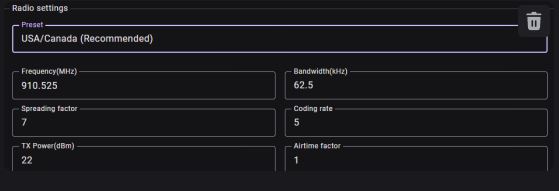
For most Meshcore deployments in the USA, the standard starting configuration is:
- Preset: USA/Canada (Recommended)
- Frequency (MHz): 910.525
- Bandwidth (kHz): 62.5
- Spreading Factor: 7
- Coding Rate: 5
- TX Power (dBm): 22
- Airtime Factor: 1
Recommended Use Cases
MeshCore is great for:
- Rapid deployment of repeaters
- Rural statewide coverage projects
- Backup communications for emergencies
- Dense repeater-based infrastructure
Meshtastic is great for:
- Advanced sensor telemetry
- MQTT and internet gateway integrations
- AD-Hoc local meshes
- Community-driven structured infrastructure
Summary
MeshCore is a great alternative LoRa mesh platform that emphasizes simplicity and repeater-friendly deployment.
- Companion Nodes are for users and mobile communication.
- Repeater Nodes form the backbone and can generally be deployed freely.
- MeshCore is easier to expand quickly, while Meshtastic offers more advanced capabilities.
Both platforms have a place in off-grid communication projects, especially in rugged environments like Maine.